Eigenvector Animation
CS-466/566: Math for AI
Module 04: Eigenvalues and Eigenvectors
Dr. Mahmoud Mahmoud
The University of Alabama
2026-03-23
TABLE OF CONTENTS
1. Eigenproblems Intuition●
2. Mathematical Properties○
3. Diagonalization○
4. Application: Google PageRank○
Eigenvectors & Eigenvalues: Intuition
Eigenvectors & Eigenvalues: Definition
Eigenvalue Equation:
\[A\mathbf{x} = \lambda \mathbf{x}\]
What it means:
- Eigenvector \(\mathbf{x}\): Direction unchanged by transformation
- Eigenvalue \(\lambda\): Scaling factor applied to that direction
- What it means: Some directions are “special” - they don’t get rotated!
TABLE OF CONTENTS
1. Eigenproblems Intuition✓
2. Mathematical Properties●
3. Diagonalization○
4. Application: Google PageRank○
Mathematical Properties
Start with: \(A\mathbf{x} = \lambda \mathbf{x}\)
Attempt to solve for \(\mathbf{x}\): \[A\mathbf{x} - \lambda \mathbf{x} = \mathbf{0}\] \[ (A - \lambda)\mathbf{x} = \mathbf{0} \quad \text{$\small❌$ (Matrix − Number is illegal)} \]
Correct way: Multiply \(\lambda\) by Identity \(I\): \[A\mathbf{x} - \lambda I \mathbf{x} = \mathbf{0}\] \[(A - \lambda I)\mathbf{x} = \mathbf{0} \quad {\small \text{✅ (Matrix - Matrix)}}\]
Steps to Find Eigenvalues & Eigenvectors
Step 1: Build characteristic polynomial \[\det(A - \lambda I) = 0\]
Step 2: Solve for eigenvalues \(\lambda_i\)
Step 3: For each \(\lambda_i\), solve \[(A - \lambda_i I)\mathbf{x} = \mathbf{0}\]
Step 4: Find basis for nullspace = eigenvectors
Example (1/5): Characteristic Equation
Matrix: \[A = \begin{bmatrix}2 & 1\\1 & 2\end{bmatrix}\]
Step 1: Setup Characteristic Equation \[ A - \lambda I = \begin{bmatrix}2 & 1\\1 & 2\end{bmatrix} - \begin{bmatrix}\lambda & 0\\0 & \lambda\end{bmatrix} = \begin{bmatrix}2-\lambda & 1\\1 & 2-\lambda\end{bmatrix} \]
Step 2: Compute Determinant \[ \det(A - \lambda I) = (2-\lambda)(2-\lambda) - (1)(1) \]
Example (2/5): Solving for Eigenvalues
Step 2 (Continued): Simplify \[ \det(A - \lambda I) = (4 - 4\lambda + \lambda^2) - 1 \] \[ = \lambda^2 - 4\lambda + 3 \]
Step 3: Solve \(\lambda^2 - 4\lambda + 3 = 0\) \[ (\lambda - 3)(\lambda - 1) = 0 \] \[ \lambda_1 = 3, \quad \lambda_2 = 1 \]
Example (3/5): Eigenvectors (\(\lambda_1 = 3\))
Solve \((A - 3I)\mathbf{x} = \mathbf{0}\)
\[ \left[\begin{array}{cc|c} 2-3 & 1 & 0 \\ 1 & 2-3 & 0 \end{array}\right] \Rightarrow \left[\begin{array}{cc|c} -1 & 1 & 0 \\ 1 & -1 & 0 \end{array}\right] \]
System of Equations: \[ -x + y = 0 \Rightarrow x = y \]
Pick a value: Let \(x=1\), then \(y=1\). Eigenvector: \(\mathbf{x}_1 = \begin{bmatrix} 1 \\ 1 \end{bmatrix}\)
Example (4/5): Eigenvectors (\(\lambda_2 = 1\))
Solve \((A - 1I)\mathbf{x} = \mathbf{0}\)
\[ \left[\begin{array}{cc|c} 2-1 & 1 & 0 \\ 1 & 2-1 & 0 \end{array}\right] \Rightarrow \left[\begin{array}{cc|c} 1 & 1 & 0 \\ 1 & 1 & 0 \end{array}\right] \]
System of Equations: \[ x + y = 0 \Rightarrow x = -y \]
Pick a value: Let \(y=1\), then \(x=-1\). Eigenvector: \(\mathbf{x}_2 = \begin{bmatrix} -1 \\ 1 \end{bmatrix}\)
Example (5/5): Summary Results
Matrix: \[A = \begin{bmatrix}2 & 1\\1 & 2\end{bmatrix}\]
Eigenvalue-Eigenvector Pairs:
Pair 1: \[ \lambda_1 = 3 \] \[ \mathbf{x}_1 = \begin{bmatrix}1\\1\end{bmatrix} \]
Pair 2: \[ \lambda_2 = 1 \] \[ \mathbf{x}_2 = \begin{bmatrix}-1\\1\end{bmatrix} \]
Computing in NumPy: eig()
import numpy as np

#> Our 2x2 Matrix from the example
A = np.array([[2, 1], [1, 2]])

#> Compute eigenvalues and eigenvectors
lambdas, vectors = np.linalg.eig(A)

print(f"Eigenvalues: {lambdas}")
print(f"Eigenvectors:\n{vectors}")
Eigenvalues: [3. 1.]
Eigenvectors:
[[ 0.70710678 -0.70710678]
[ 0.70710678 0.70710678]]Note: The eigenvectors are normalized (length = 1).
Pattern Discovery
Look at our results from the previous example: \[ \lambda_1 = 3, \quad \lambda_2 = 1 \] \[ \text{Sum} = 4, \quad \text{Product} = 3 \]
Look at the original matrix: \[ A = \begin{bmatrix}2 & 1\\1 & 2\end{bmatrix} \] \[ \text{Trace (sum of diagonal)} = 2 + 2 = 4 \] \[ \text{Determinant} = (2)(2) - (1)(1) = 3 \]
Coincidence? I think not! 🤔
Mathematical Properties
Algebraic Definition
Characteristic Equation: Values \(\lambda\) where matrix becomes singular \(\det(A - \lambda I) = 0\)
Null Space: Vectors \(\mathbf{x}\) in the null space of shift \((A - \lambda I)\mathbf{x} = \mathbf{0}\)
Verify Your Results
Sum Rule (Trace): Sum of diagonal = Sum of eigenvalues \[ \text{tr}(A) = \sum \lambda_i \]
Product Rule (Determinant): Determinant = Product of eigenvalues \[ \det(A) = \prod \lambda_i \]
Your Turn: Quick Check
Matrix: \[ B = \begin{bmatrix} 3 & 1 \\ 1 & 3 \end{bmatrix} \]
Task: Find the eigenvalues without solving the characteristic polynomial!
Trace: \(3 + 3 = 6\) \[ \Rightarrow \lambda_1 + \lambda_2 = 6 \]
Determinant: \(9 - 1 = 8\) \[ \Rightarrow \lambda_1 \cdot \lambda_2 = 8 \]
Find two numbers that sum to 6 and multiply to 8: \[ \lambda_1 = 4, \quad \lambda_2 = 2 \]
TABLE OF CONTENTS
1. Eigenproblems Intuition✓
2. Mathematical Properties✓
3. Diagonalization●
4. Application: Google PageRank○
The Matrix of Eigenvectors
Collect all eigenvectors into one matrix \(C\)
\[ C = \begin{bmatrix} | & | & & | \\ \mathbf{x}_1 & \mathbf{x}_2 & \cdots & \mathbf{x}_n \\ | & | & & | \end{bmatrix} \]
And eigenvalues into a diagonal matrix \(D\)
\[ D = \begin{bmatrix} \lambda_1 & 0 & \cdots & 0 \\ 0 & \lambda_2 & \cdots & 0 \\ \vdots & \vdots & \ddots & \vdots \\ 0 & 0 & \cdots & \lambda_n \end{bmatrix} \]
Key Relationship
\[ AC = CD \implies A = CDC^{-1} \]
Matrix Exponentiation
Question: How to compute \(A^k\) efficiently for \(n \times n\) matrix? (Naive: \(O(kn^3)\))
Lets transform a vector \(\mathbf{x}\) by \(A\) for \(k\) times: \[ A^k \mathbf{x} \]
Better Way for Matrix Exponentiation
Proof Strategy: Check what happens to \(A^k\)
\[ A^k = \underbrace{A \cdot A \cdot A \cdots A}_{k \text{ times}} \]
Substitute \(A = CDC^{-1}\):
\[ A^k = (CDC^{-1}) (CDC^{-1}) (CDC^{-1}) \cdots (CDC^{-1}) \]
Cancel Internal Terms:
\[ A^k = C D (\underbrace{C^{-1}C}_{I}) D (\underbrace{C^{-1}C}_{I}) D \cdots (\underbrace{C^{-1}C}_{I}) D C^{-1} \]
Result (Powers of Diagonal Matrix): \[ A^k = C D^k C^{-1} \]
Conclusion: \(A^k\) scales eigenvectors by \(\lambda^k\)
TABLE OF CONTENTS
1. Eigenproblems Intuition✓
2. Mathematical Properties✓
3. Diagonalization✓
4. Application: Google PageRank●
The “Billion Dollar” Eigenvector
The Question How does Google search rank billions of webpages?
The Intuition - A page is “important” if important pages link to it. - It’s a popularity contest… but weighted!
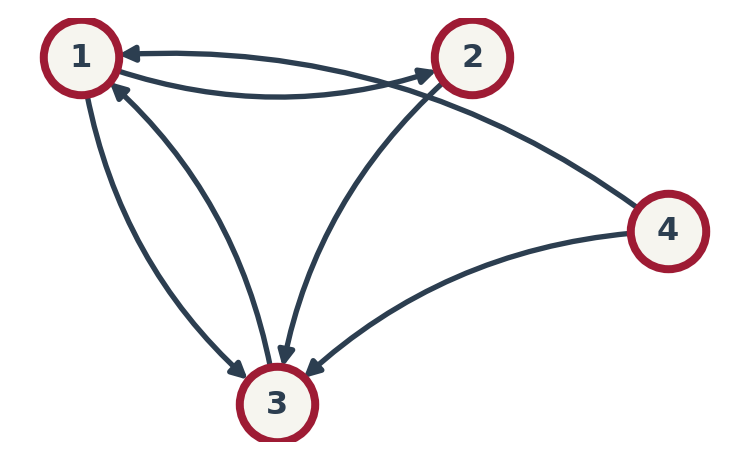
The Web as a Matrix
Rule: If Page \(j\) links to Page \(i\), it “votes” for \(i\). \(M_{ij} = P(j \to i)\).
How to build Column \(j\) (Page \(j\)):
- Count outgoing links \(k\).
- Put \(1/k\) in rows of target pages.
Example:
- Col 1 (Page 1): Links to {2, 3} (\(k=2\)). \(\Rightarrow\) Rows 2 & 3 get \(1/2\).
- Col 3 (Page 3): Links to {1} (\(k=1\)). \(\Rightarrow\) Row 1 gets \(1/1 = 1\).
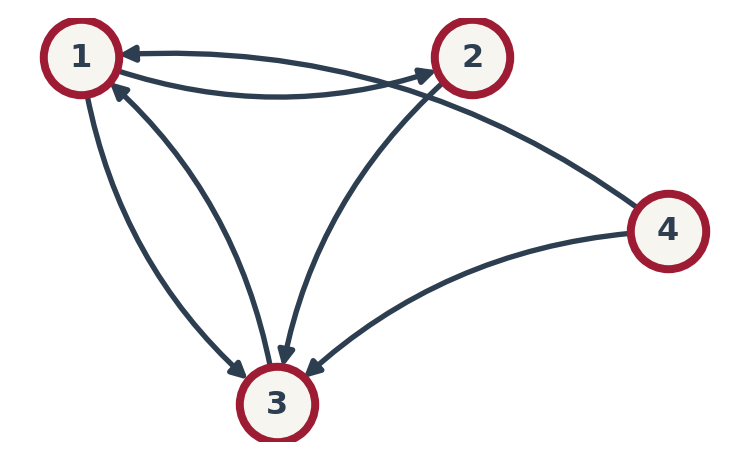
Example Matrix \(A\): \[ A = \begin{bmatrix} 0 & 0 & 1 & 1/2 \\ 1/2 & 0 & 0 & 0 \\ 1/2 & 1 & 0 & 1/2 \\ 0 & 0 & 0 & 0 \end{bmatrix} \]
The Eigenvector Connection
Let \(r\) be the rank vector. The rank of page \(i\) is the weighted sum of ranks pointing to it.
Example for Page 3: \[ r_3 = \frac{1}{2}r_1 + 1 \cdot r_2 + \frac{1}{2}r_4 \]
(Matches Row 3 of \(A\): \([1/2, 1, 0, 1/2]\))
This applies to all pages simultaneously: \[ \begin{bmatrix} r_1 \\ r_2 \\ r_3 \\ r_4 \end{bmatrix} = \begin{bmatrix} 0 & 0 & 1 & 1/2 \\ 1/2 & 0 & 0 & 0 \\ 1/2 & 1 & 0 & 1/2 \\ 0 & 0 & 0 & 0 \end{bmatrix} \begin{bmatrix} r_1 \\ r_2 \\ r_3 \\ r_4 \end{bmatrix} \] \(\implies \mathbf{r} = A \mathbf{r}\)
Look familiar? \[ A \mathbf{r} = 1 \cdot \mathbf{r} \] PageRank is finding the eigenvector for \(\lambda = 1\)!
How to Compute it?
We need to solve \(A\mathbf{r} = \mathbf{r}\) for billions of pages.
The Naive Way Gaussian Elimination (\(O(n^3)\))
- For \(n = 10^9\), this takes forever.
The Efficient Way Power Iteration:
- Start with random \(\mathbf{r}_0\).
- \(\mathbf{r}_{k+1} = A \mathbf{r}_k\).
- Repeat until convergence.
Why it works? Recall: \(A^k\) scales eigenvectors by \(\lambda^k\). Expand \(\mathbf{r}_0\) as sum of eigenvectors: \(\mathbf{r}_0 = c_1 \mathbf{v}_1 + c_2 \mathbf{v}_2 + \dots\) \[ A^k \mathbf{r}_0 = c_1 (1)^k \mathbf{v}_1 + c_2 (\underbrace{\lambda_2}_{<1})^k \mathbf{v}_2 + \dots \] As \(k \to \infty\), the small eigenvalues die (\(0.5^{100} \approx 0\)). Only \(\mathbf{v}_1\) remains!
PageRank in NumPy: Defining the Matrix
Note: We use np.array to store \(A\). For real web graphs, we would use scipy.sparse to save memory!
PageRank in NumPy: Eigen-Solution
#> Compute eigenvalues and eigenvectors
lambdas, vectors = np.linalg.eig(A)
print(f"Eigenvalues: {lambdas}")

#> Find the index of the eigenvalue nearest to 1.0
idx = np.where(np.isclose(lambdas, 1.0, atol=1e-8))[0][0]
rank_vector = vectors[:, idx].real

#> Normalize (so values sum to 1)
rank_vector = rank_vector / np.sum(rank_vector)

print(f"PageRank: {rank_vector}")
Eigenvalues: [ 1. +0.j -0.5+0.5j -0.5-0.5j 0. +0.j ]
PageRank: [ 0.4 0.2 0.4 -0. ]Insight: This is the “Exact” solution. It’s fast for small matrices but \(O(n^3)\) for large ones.
PageRank in NumPy: Power Iteration
#> Iterative multiplication
r0 = np.array([0.25, 0.25, 0.25, 0.25])
r_k = r0
for i in range(20):
    r_k = A @ r_k

print(f"Iterative Result: {r_k}")
Iterative Result: [0.40014648 0.1998291 0.40002441 0. ]Efficiency: This only requires Matrix-Vector multiplication (\(O(\text{Links})\)), which is why Google can scale it to billions of pages!
Thank You!



The University of Alabama